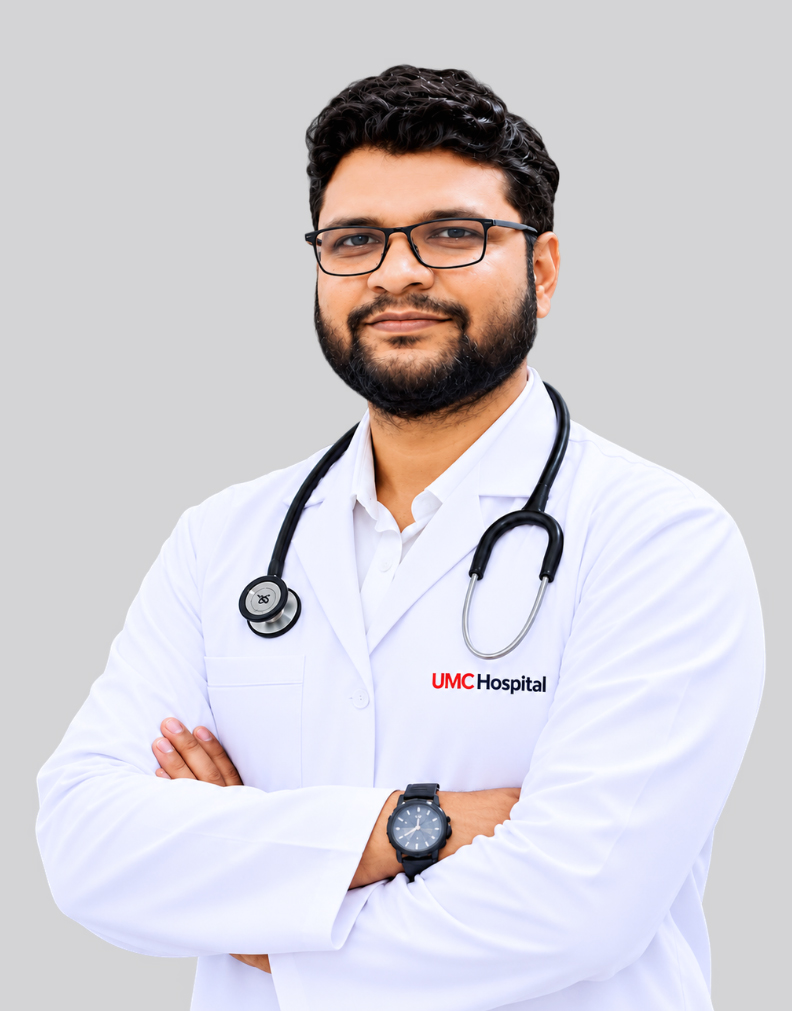
Best Orthopaedic Hospital in Nashik
The Department of Orthopaedics & Spine Surgery at UMC Hospitals offers comprehensive, consultant-led care for conditions affecting bones, joints, muscles, ligaments, tendons, and the spine. Recognized as one of the best orthopaedic hospitals in Nashik, our team manages everything from fractures and sports injuries to advanced joint replacement and complex spine surgery. We help patients understand how the problem is affecting daily movement, work, and quality of life, and plan treatment accordingly.
Conditions We Treat
-
Fractures and Trauma
From minor wrist fractures after a fall to complex multi-bone injuries following road accidents, managed with casting, fixation, or staged reconstruction depending on severity.
-
Joint Disorders
Osteoarthritis, rheumatoid arthritis, avascular necrosis, cartilage and ligament injuries, and joint deformities. Delay in seeking care often allows these conditions to worsen.
-
Spine Conditions
Lower back pain, cervical spondylosis, disc prolapse, spinal canal stenosis, spondylolisthesis, and deformities such as scoliosis, both managed conservatively and surgically where indicated.
-
Sports Injuries
ACL and PCL tears, meniscus injuries, shoulder instability, rotator cuff tears, and recurrent ankle sprains.
-
Joint Replacement
Partial and total knee, hip, and shoulder replacement for advanced arthritis, including revision surgeries when older implants fail.
-
Hand and Upper Limb
Carpal tunnel syndrome, tendon injuries, nerve compression, and contractures affecting grip and hand function.
-
Foot and Ankle
Plantar fasciitis, Achilles disorders, flatfoot, bunions, ligament injuries, and deformity correction.
-
Paediatric Orthopaedics
Bow legs, knock knees, club foot, and delayed walking, assessed carefully to distinguish normal development from conditions requiring intervention.
Common Symptoms
Pain that starts after climbing stairs or walking on uneven ground, stiffness in the mornings that takes more than thirty minutes to ease, a joint that swells repeatedly without injury - these are not things to wait on. Other symptoms worth paying attention to include:
-
Persistent back or neck pain that radiates into the arms or legs.
-
Numbness, tingling, or weakness in the hands or feet.
-
A joint that locks, gives way, or feels unstable during normal activity.
-
Difficulty standing straight, or a visible change in posture or spinal alignment.
-
Swelling, deformity, or inability to bear weight after a fall or accident.
-
A grinding or clicking sensation in the knee or hip that is getting worse over time.
Services and Treatment Options
-
General Orthopaedics and Trauma
Fracture management ranges from casting and splinting to surgical fixation with plates, rods, or screws. Complex injuries may require staged approaches and limb reconstruction. Soft tissue injuries, tendon repairs, and nerve decompressions are managed alongside bone conditions as part of comprehensive limb care.
-
Joint Replacement
Our joint replacement programme focuses on appropriate patient selection, correct implant choice, and precise alignment. Pain control begins before surgery and continues through recovery. Most patients are mobilized within twenty-four hours of a knee or hip replacement.
-
Spine Surgery
Spine care at UMC Hospitals covers the full range - from conservative management with physiotherapy and injections to surgical decompression, disc surgery, and spinal fusion where required. The spine team assesses each patient carefully before recommending surgery.
-
Arthroscopy and Sports Medicine
Minimally invasive keyhole procedures for the knee, shoulder, hip, and ankle to treat ligament, meniscus, labrum, and cartilage injuries. Return-to-activity decisions are guided by functional testing and gradual reconditioning, not just time elapsed since surgery.
-
Rehabilitation and Physiotherapy
Physiotherapy plans are tailored to the individual, not a printed sheet of generic exercises. A patient recovering from ACL surgery follows a very different protocol from someone after a spinal decompression. Orthotics and prosthetic support are incorporated where needed.
Diagnosis
The diagnostic tools used include:
-
Digital X-rays for quick assessment of fractures, arthritis, and alignment.
-
MRI for detailed evaluation of soft tissue, disc, ligament, and spinal cord conditions.
-
CT scans are used when fracture complexity or implant planning requires greater detail.
-
Ultrasound for shoulder, tendon, and soft tissue assessment, including guided injections.
-
Nerve conduction studies for suspected nerve compression or peripheral neuropathy.
-
Bone density scans for osteoporosis assessment
Consult the best orthopaedic surgeons in Nashik at UMC Hospitals for comprehensive diagnosis and treatment.
Prevention
Bone and joint problems are not inevitable, even with age. Several risk factors can be meaningfully reduced:
-
Maintain a healthy weight, as every extra kilogram adds significant load to the knees and hips over time.
-
Stay physically active with low-impact exercise such as walking, swimming, or cycling to preserve joint and muscle strength.
-
Build and maintain bone density through adequate calcium and vitamin D. Deficiency is extremely common in urban Indian patients and often goes undetected.
-
Avoid prolonged sitting or standing in one position, particularly for those with desk jobs or jobs requiring heavy manual labour.
-
Wear supportive footwear - unsupported flat feet and poor footwear choices contribute more to knee and back pain than most patients realize.
-
Seek early assessment after any injury rather than waiting to see if it settles - untreated ligament and joint injuries often lead to long-term instability.
-
Postmenopausal women and elderly patients should discuss osteoporosis screening proactively, even without symptoms.
When to See a Doctor
Consider consulting an orthopaedic specialist if joint or back pain continues for more than two to three weeks despite rest or begins to interfere with sleep, work, or everyday activities. Medical evaluation is also recommended after a fall or injury if you are unable to bear weight, experience significant pain, or notice visible swelling or deformity. If you have been advised to undergo joint replacement elsewhere and would like to understand your diagnosis and treatment options, a consultation with an orthopaedic specialist can provide further guidance. Individuals over 50 may also discuss bone health and osteoporosis screening with their doctor, particularly if they have relevant risk factors.
Why Choose UMC Hospitals for Orthopaedic Treatment in Nashik?
UMC Hospitals provides comprehensive orthopaedic treatment in Nashik, with a focus on restoring mobility, reducing pain, and supporting patients throughout their recovery.
-
Consultant-led orthopaedic care with subspecialists in joint replacement, spine surgery, sports injuries, trauma, and paediatric orthopaedics.
-
Minimally invasive techniques are used where they offer a genuine benefit
-
Integrated rehabilitation with physiotherapy, pain management, and orthotics coordinated under one system, reducing delays between surgery and recovery.
-
Joint replacement programme with early mobilisation, structured pain control, and ERAS protocols to shorten hospital stay and improve recovery outcomes.
FAQs
-
Is surgery always necessary for joint pain or back pain?
Not always. A significant number of patients improve with physiotherapy, weight management, anti-inflammatory medication, and guided injections. Surgery is considered when conservative treatment does not work.
-
How long do knee or hip implants last?
Modern implants typically last fifteen to twenty years or more, though this varies with activity level, body weight, and bone quality. Your surgeon will discuss implant options and realistic expectations at the time of consultation.
-
What is the recovery time after spine surgery?
It depends on the procedure. Many patients who undergo disc surgery or decompression are walking the same day and are discharged within two to three days. More complex spinal fusion surgeries require a longer recovery.
-
How soon can I walk after a knee or hip replacement?
Most patients are assisted to stand and take a few steps within twenty-four hours of surgery. Walking with support begins almost immediately, and most patients are moving independently within a few days.
-
Is physiotherapy really necessary after orthopaedic surgery?
Yes. Without guided rehabilitation, recovery often remains incomplete - even when the surgery itself went well. Physiotherapy restores strength, range of motion, and confidence in the joint, and is as important as the procedure itself.
-
Can back pain be treated without surgery?
In the majority of cases, yes. Most disc prolapses, nerve compressions, and degenerative spine conditions respond to a structured combination of physiotherapy, pain management, and activity modification. Surgery is reserved for cases where neurological function is at risk or conservative treatment has failed over an adequate period.